
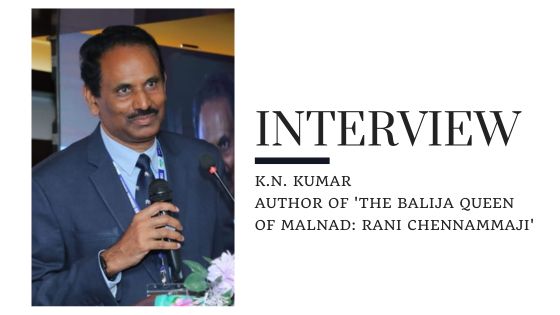
About K.N. Kumar
A former civil servant, K.N.Kumar served the states of Assam and Meghalaya, as well as the Government of India, over a career spanning more than three decades. A Master’s degree in Agriculture from A.P. Agricultural University prepared him to focus on the primary sector covering agriculture, horticulture, fisheries, and animal husbandry, leading him to become the Joint Secretary in Agriculture, to the Government of India, the Chief Executive of the National Fisheries Development Board and the Deputy Director General, at the National Institute of Rural Development, Hyderabad. He was also the Chairman of the Meghalaya Farmers’ Commission at Shillong, a position he held till 2024. He holds a Master’s in Public Administration from the Kennedy School of Government at Harvard University.
LiFT: Tell us about your book, the journey of writing it, and its content.
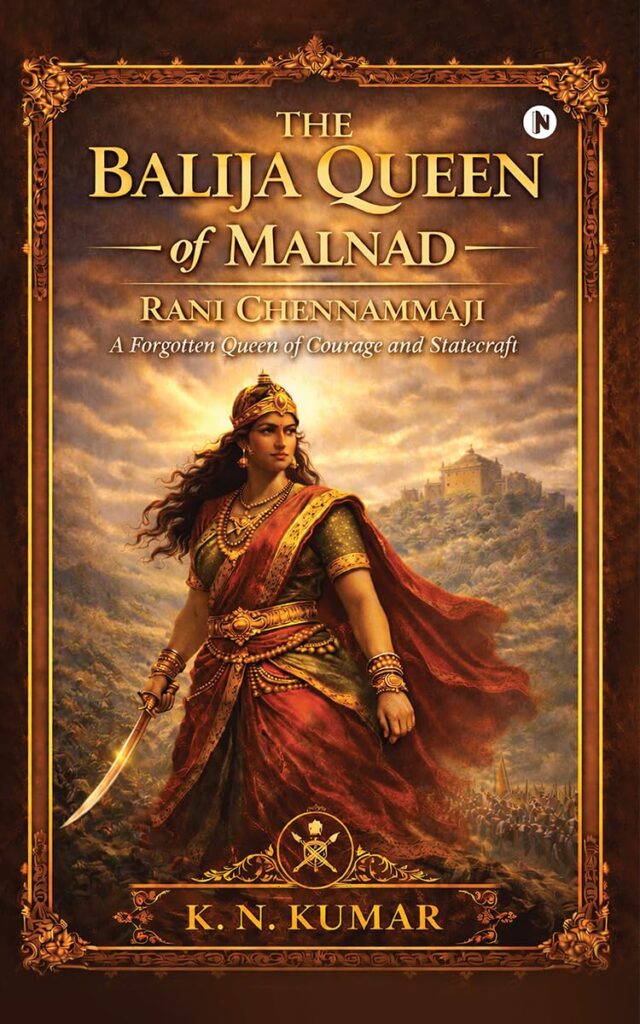
K.N. Kumar: It was about a year ago that I happened to visit Madikere when I heard about Rani Chennamma of Keladi and the brave fight she had gotten into with Aurangzeb because of an asylum she had granted to Rajaram, the second son of Chhatrapati Shivaji. After Shambhaji Maharaj was executed by Aurangzeb, Rajaram led the Maratha rebellion. Aurangzeb pursued him to the deep south. Rajaram needed protection, and then the Queen of Keladi, Rani Chennammaji gave him refuge, knowing full well the likely consequences. Aurangzeb sent his son, Jan Nisar Khan, to capture Rajaram, but the Queen stood her ground and fought the Mughal army. In the process, she ensures Rajaram’s safe passage, and the war ends with a Treaty. Hers is a story of valour, courage, dharma, and a deep sense of right and wrong. I felt the need to bring up her story because I didn’t get to see any serious work on her life and times in English.
LiFT: Why did you choose this title?
K.N. Kumar: Basically, because at almost every stage of her life she followed the Veera Balanjya Dharma, a mercantile warrior ethic of her community, the Balijas. I saw the centrality of the Balija world in her social and administrative world. Ignoring that aspect of her social origins would have been a shallow exercise. So I wanted to go deep into it and analyse how her community played a critical role in her life and in how she administered her land.
LiFT: When did you realize that you wanted to be a writer, and what was your inspiration behind it?
K.N. Kumar: I had been writing for a while in the newspapers on a range of subjects. Writing a serious book was always in the back of my mind, but I did not really get around to it for several reasons, my profession being one major reason. Once I moved out of it, I started finding time for work, such as this, that needed some serious research.
LiFT: Where do you see yourself ten years down the line in the world of literature?
K.N. Kumar: A writer who brings to light the stories of the forgotten heroes and heroines of our country who were impactful, but largely ignored by our mainstream historians.
LiFT: How important do you think marketing and the quality of a book are in promoting it and increasing its readership?
K.N. Kumar: They are very important. Readers can make a choice only when they learn there is a book like this.
LiFT: What message do you want to convey to people through your writing?
K.N. Kumar: There are several stories of people who fought for what they believed was right and upheld the Dharma, but mainstream history may not have known of them or treated them as inconsequential. A country that cannot remember its heroes/heroines cannot produce new heroes/heroines. It is time we made a concerted effort to express our gratitude to them.
LiFT: What do you do apart from writing?
K.N. Kumar: I am a passionate organic farmer.
LiFT: What activities do you resort to when you face writer’s block?
K.N. Kumar: I go out for a walk. Usually, I break it when I walk for about an hour. And often, letting the issue incubate for a small period helps. There is always some neural connection that will materialize at unexpected times.
LiFT: Are you working on your next book? If so, could you tell us something about it?
K.N. Kumar: Yes. I am convinced that our Democracy is regressing into a dysfunctional system, and it needs major repairs. So, my next book will be titled something like ‘The Delusion of Democracy’.
LiFT: What are your suggestions for budding writers and poets to help them improve their writing skills?
K.N. Kumar: Once you have an idea to work on, jump into it, go for a deep dive. Don’t postpone. Simply start writing. Information is much easier to get nowadays than before.
Click here to order K.N. Kumar’s Book – The Balija Queen of Malnad: Rani Chennammaji
2 thoughts on “In Conversation with K.N. Kumar”
Interesting read….the author’s observation that a nation that fails to remember, record and recognise it’s unsung yet real heros and heroines cannot produce such great warriors again is a pointer to where the system fails, again and again…
Congratulations to him for choosing this title…
Dr Ramanujan Jayaraman
Rotterdam
The Netherlands
Thanks Dr.Ramanujan for validating a conviction. Grateful.