About Ashritta Saran
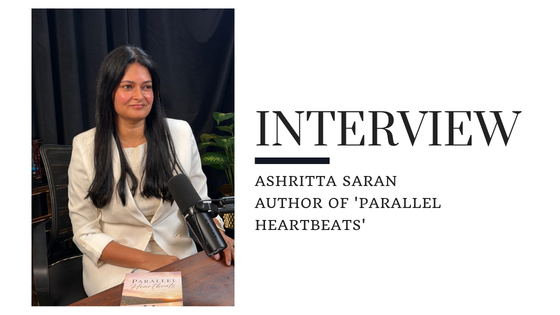
Ashritta Saran is a public health researcher and debut novelist based in New Delhi, India.
She trained as a dentist before transitioning into public health, where she has spent over a decade as a methods leader in evidence synthesis. She currently serves as Director in an international research organisation, leading work in systematic reviews, evidence and gap maps, and research methodology across international development, with a focus on low- and middle-income countries. She holds an MPH in epidemiology and completed her PhD in public health in 2026.
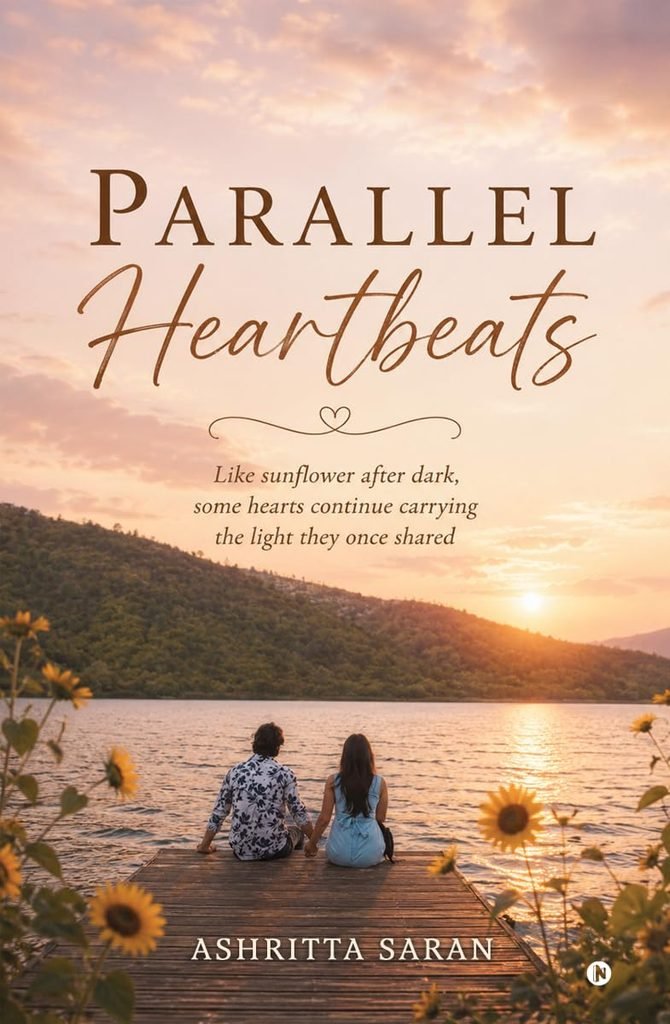
Parallel Heartbeats is her debut novel, written over nearly a decade alongside her research career. Set in Lucknow, it follows two people who find each other too young and spend years learning what love actually costs once ambition, distance, and family expectation are involved. The novel is drawn in part from her own life.
Ashritta lives and works between New Delhi.
LiFT: Tell us about your book, the journey of writing it, and its content.
Ashritta Saran: Parallel Heartbeats is set in Lucknow and follows Ash and Aaryan — two people who find each other too young, as friends first, long before either of them has a word for what it’s becoming. As they grow older, ambition, distance, and the quiet weight of family expectation test what they’ve built, forcing them to ask a harder question than whether they love each other: whether love, on its own, was ever going to be enough. This one took me almost a decade, on and off. I started it as a much younger woman, then trained as a dentist, then moved into public health research — a career built entirely on evidence, rigor, and not accepting an answer until it’s been properly checked. The manuscript sat untouched for long stretches while all of that happened. I think I only finished it once I had enough distance from who I was when I started it to write the ending honestly, rather than the version 19-year-old me would have written. It’s contemporary romance, but written to resist the genre’s usual pull toward melodrama. Nothing here is rushed — Ash and Aaryan don’t fall in love with fireworks, they fall into it the way real people do, through ordinary time spent together. It’s drawn, in part, from something real in my own life, and it’s ultimately less about the moment two people fall in love and more about what’s left of that connection years later, once life has asked everything of it.
LiFT: Why did you choose this title?
Ashritta Saran: I chose Parallel Heartbeats because it’s the most honest way I could describe what Ash and Aaryan’s connection actually looks like over the course of the book.
Parallel lines never touch — they run alongside each other, close, in the same direction, but separate. That felt truer to their relationship than any language about hearts “becoming one” or love “completing” someone. Ash and Aaryan spend years moving in the same rhythm as each other — same intensity, same quiet persistence — even during the stretches when circumstance, distance, or timing keeps them apart. Their hearts were never merged into a single beat. They were always two, moving in sync, side by side, even when life kept them from being in the same place.
“Heartbeats” mattered too, because I wanted something physical and involuntary — a heartbeat isn’t a decision you make, it just happens, the way I think real connection often does. You don’t choose to keep loving someone the way you’d choose a plan. It just keeps happening in the background, whether or not the timing cooperates.
Put together, the title is really the whole book in two words: two people, staying in rhythm with each other, long after they stopped being in the same place.
LiFT: When did you realize that you wanted to be a writer, and what was your inspiration behind it?
Ashritta Saran: Honestly, I don’t think I ever sat down and decided to become a writer — this particular story decided for me. I remember it showing up uninvited, usually late at night, the kind of feeling that doesn’t let you sleep until you’ve put some of it down on paper. I was young when that started, young enough to think a story that big could be finished quickly.
My inspiration wasn’t a writer I admired or a genre I set out to work in — it was something closer to necessity. Parallel Heartbeats is drawn from something real in my own life, and I think I needed to write it more than I ever decided to. Writing it down was how I worked out a question I didn’t have language for yet: whether love, by itself, is ever enough.
So if I’m being precise about it — I’m not sure I became a writer so much as I became someone who finally finished something that had been asking to be written for a very long time.
LiFT: Where do you see yourself ten years down the line in the world of literature?
Ashritta Saran: Honestly, I’m cautious about answering this one too confidently — this book alone took me almost a decade, so I’ve learned not to make bold promises about timelines when it comes to writing.
What I do know is that I don’t want to become someone who writes quickly just to stay visible. If anything, Parallel Heartbeats taught me the opposite lesson — that some stories need the time they need, and rushing them costs the book something real. Ten years from now, I’d rather have written two or three novels I fully stand behind than a dozen I rushed through.
I’d also like to keep doing what I’m doing right now, in a sense — letting fiction sit alongside my research work rather than replacing it. There’s something about spending my days in evidence and rigor that actually makes the freedom of fiction feel more meaningful, not less. I don’t see myself choosing one over the other.
If I’m honest, my real hope for ten years from now isn’t about output at all — it’s that if someone picks up whatever I’ve written by then, it still feels like it was worth the wait.
LiFT: How important do you think marketing and the quality of a book are in promoting it and increasing its readership?
Ashritta Saran: Having gone through the process of publishing my own debut, I’d say they’re not actually in competition with each other — they solve two completely different problems, and a book usually needs both to succeed.
Quality is what makes a reader trust you the next time. No amount of marketing fixes a book that doesn’t deliver once someone actually opens it — if anything, strong marketing without the writing to back it up just gets you a wave of disappointed first readers, and word of mouth works against you instead of for you.
But I’ve also learned, very directly, that quality alone doesn’t guarantee anyone finds the book in the first place. There are an enormous number of well-written books that never reach the readers who would have loved them, simply because discovery is genuinely difficult now — between algorithms, saturated categories, and the sheer volume of what’s published every day. I didn’t fully understand this until I was the one trying to get my own book in front of people. Writing it was the hardest part emotionally, but getting it seen has been its own entirely different kind of work.
If I had to put it simply: quality earns you the reader who finishes your book and remembers it. Marketing is what gets that first reader to pick it up at all. You need the first to make the second worth doing, and you need the second for the first to matter to anyone beyond the people who already know you.
LiFT: What message do you want to convey to people through your writing?
Ashritta Saran: If there’s one thing I hope people take from Parallel Heartbeats, it’s this: the love that shapes us most isn’t always the love that lasts, and that doesn’t make it any less worth having mattered.
We tend to measure relationships by whether they succeeded — did it last, did it end in marriage, did it “work out.” I wanted to write something that pushes back on that a little. Some connections do their job simply by teaching us what it feels like to be truly known by another person, even if life eventually asks something of us that the relationship can’t survive. That’s not failure. That’s just what it costs, sometimes, to have loved someone fully.
I also want readers to notice something quieter underneath that: the people who are simply consistent — who stay, who show up, who choose you again on the ordinary days, not just the dramatic ones — are usually the ones worth paying attention to. Not the grand gesture. The staying.
If someone finishes this book and calls an old friend, or sits a little longer with a memory of someone who mattered to them once, I think I’ll have said what I meant to say.
LiFT: What do you do apart from writing?
Ashritta Saran: Writing is actually the newer, smaller part of my life — my primary work is in public health research.
I trained as a dentist originally, then moved into public health, where I now lead evidence synthesis work — systematic reviews, evidence and gap maps, and research methodology, largely focused on low- and middle-income countries. I currently serve as Director of Evaluation and Evidence Synthesis at the Global Development Network, and Director of Research at the Research and Evaluation Centre. Most of my working life involves things like cost-effectiveness analysis, climate and international development research, and increasingly, how AI can be responsibly applied to research methodology itself.
It’s a strange contrast, some days — spending my mornings in evidence, rigor, and methodology, and then coming home to write fiction about the one thing that never fits neatly into a framework: love, and what it costs. But I’ve come to think the two feed each other more than they compete. The patience research teaches you — sitting with a question for a long time before you’re allowed to answer it — is, I think, exactly what let me finally finish this book.
LiFT: What activities do you resort to when you face writer’s block?
Ashritta Saran: Honestly, I don’t fight writer’s block head-on anymore — I’ve learned it usually isn’t a sign to push harder, it’s a sign I’m forcing the wrong scene at the wrong time.
So when it happens, I switch to a different scene or chapter entirely and come back to the one that’s stuck later. Sometimes a scene isn’t ready to be written yet because I haven’t fully understood the characters’ state of mind at that point in the story — and trying to force it just produces something flat. Moving to a part of the book I do feel ready to write keeps the momentum going, and more often than not, by the time I circle back, I understand the stuck scene differently.
Given that this book took me the better part of a decade, on and off, I think that approach is really just how I made peace with the fact that not everything gets written in order, or on schedule. Some scenes are ready before others. I’ve stopped fighting that.
LiFT: What if your story were to be adapted into a movie? Who would you want to work as the director or actors in it?
Ashritta Saran: Honestly, I don’t have a dream cast or director in mind — I’ve never let myself imagine this book as a film in that much detail.
If it ever did become one, the only thing I’d actually care about is that whoever takes it on genuinely believes in the story — not just its commercial potential, but the quieter, more restrained version of love it’s trying to tell. This isn’t a book built on dramatic, cinematic moments; it’s built on accumulation, small gestures, and things left unsaid. I’d want a director and cast who understand that the emotional weight lives in the pauses, not just the big scenes — people who’d trust silence and restraint the way I tried to on the page, rather than pushing it toward melodrama just because that translates more easily to screen.
Beyond that, I’d genuinely rather it go to someone who connects with the story than someone with the biggest name attached. That matters more to me than any specific person I could name.
LiFT: Are you working on your next book? If so, could you tell us something about it?
Ashritta Saran: Yes, I am — but I’d rather not say much about it just yet. I’ll announce it properly when the time is right.
I will say this: after nearly a decade with Parallel Heartbeats, I’ve learned not to talk about a story before it’s ready to be talked about. So for now, I’m just going to let this one exist a little longer before I start sharing the next.
LiFT: What are your suggestions for budding writers and poets to help them improve their writing skills?
Ashritta Saran: The advice I’d give comes directly from what I got wrong for a long time: I used to think writing had to happen quickly, or not at all. It doesn’t. Some of my best writing came from returning to a story after years away, with more life behind me than when I started it.
A few things I’d actually suggest:
Let a story wait if it needs to. Not every scene is ready to be written the day you sit down for it. If you’re stuck, don’t force it — move to a part of the story you do feel ready to write, and come back later. Forcing a scene before you understand it usually produces something flat.
Read like you’re studying, not just enjoying. Notice what a sentence is doing, not just what it says. I didn’t come from a formal writing background — my instincts were shaped as much by reading closely as by writing.
Don’t confuse speed with progress. A book that takes years isn’t a failed process — sometimes it’s the only way a particular story can be told honestly. I finished mine only once I had enough distance from who I was when I started it.
Write the version that’s true, not the version that’s easy. It’s tempting to smooth over the harder, more complicated parts of a story. The moments I almost cut from my own book are usually the ones readers mention first.
Give yourself permission to have a life outside writing. I built an entire career in public health research alongside this book. I don’t think that slowed the book down — I think it’s part of why it eventually became what it needed to be.
Click here to order Ashritta Saran’s Book – Parallel Heartbeats